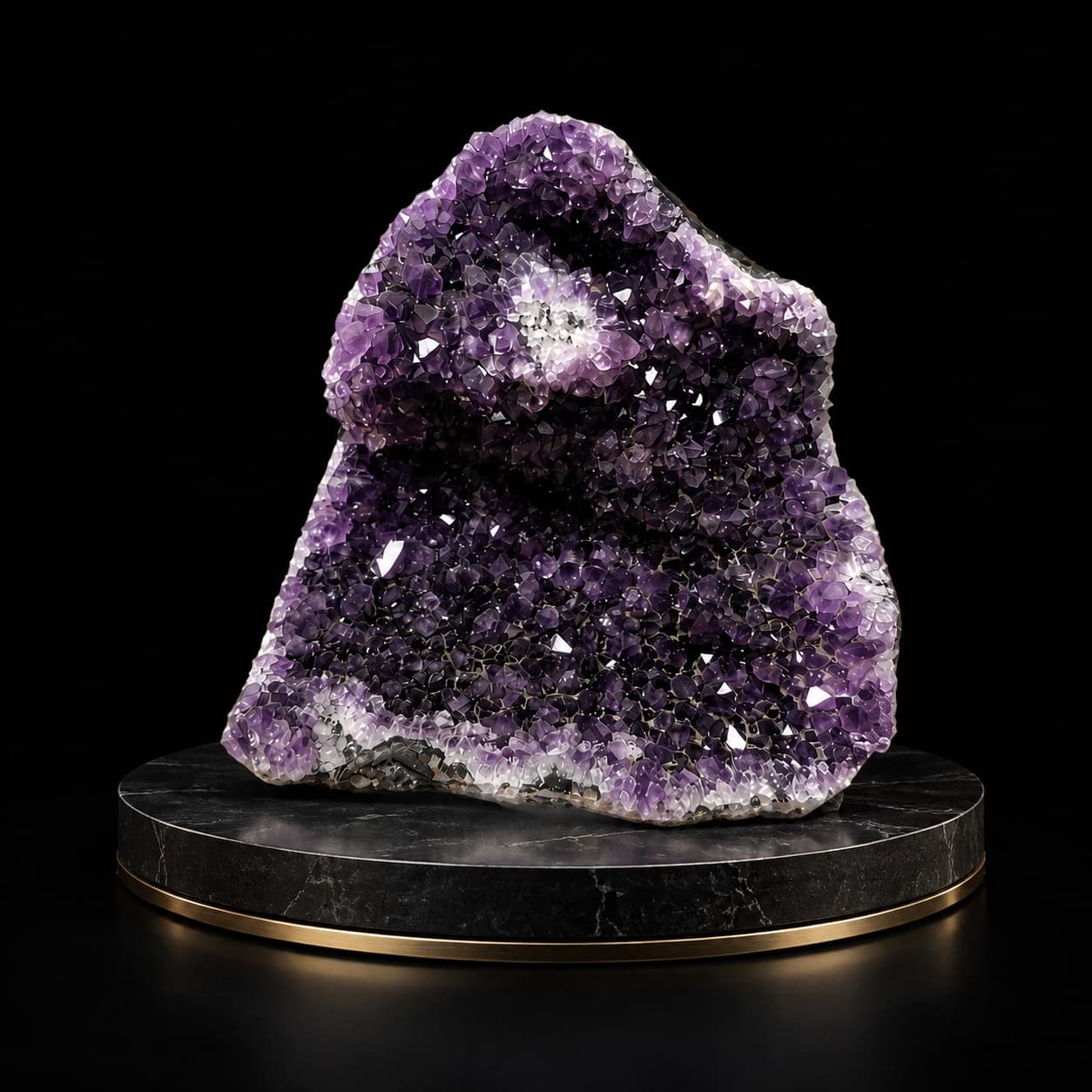
Amethyst
Amethyst, purple quartz
- Class
- Silicate (Quartz variety)
- Chemical Formula
- SiO2
- Mohs Hardness
- 7
- Color
- Purple, violet
- Crystal System
- Trigonal
- Transparency
- Transparent to translucent
- Luster
- Vitreous
- Streak
- White
- Specific Gravity
- 2.65 – 2.66
Overview
Amethyst is the purple variety of quartz, prized for its deep color and six-sided crystal points. It's one of the most valued members of the quartz family.
Formation
Amethyst forms inside gas cavities in volcanic rock (geodes), where trace iron and natural irradiation give quartz its characteristic purple hue.
Geographic Locations
Brazil, Uruguay, Zambia, Russia (Urals), Armenia.
History
The ancient Greeks believed amethyst protected against intoxication — the name comes from the Greek "amethystos," meaning "not drunk."
Cultural Significance
For centuries amethyst has symbolized royal power and spiritual protection, appearing in church and royal regalia alike.
Interesting Facts
Amethyst's color can fade with prolonged sun exposure. When heated, it can turn into yellow-orange citrine.
Identification
Identified by its purple hue, high hardness (7), and glassy (vitreous) luster; often confused with fluorite, which is considerably softer.